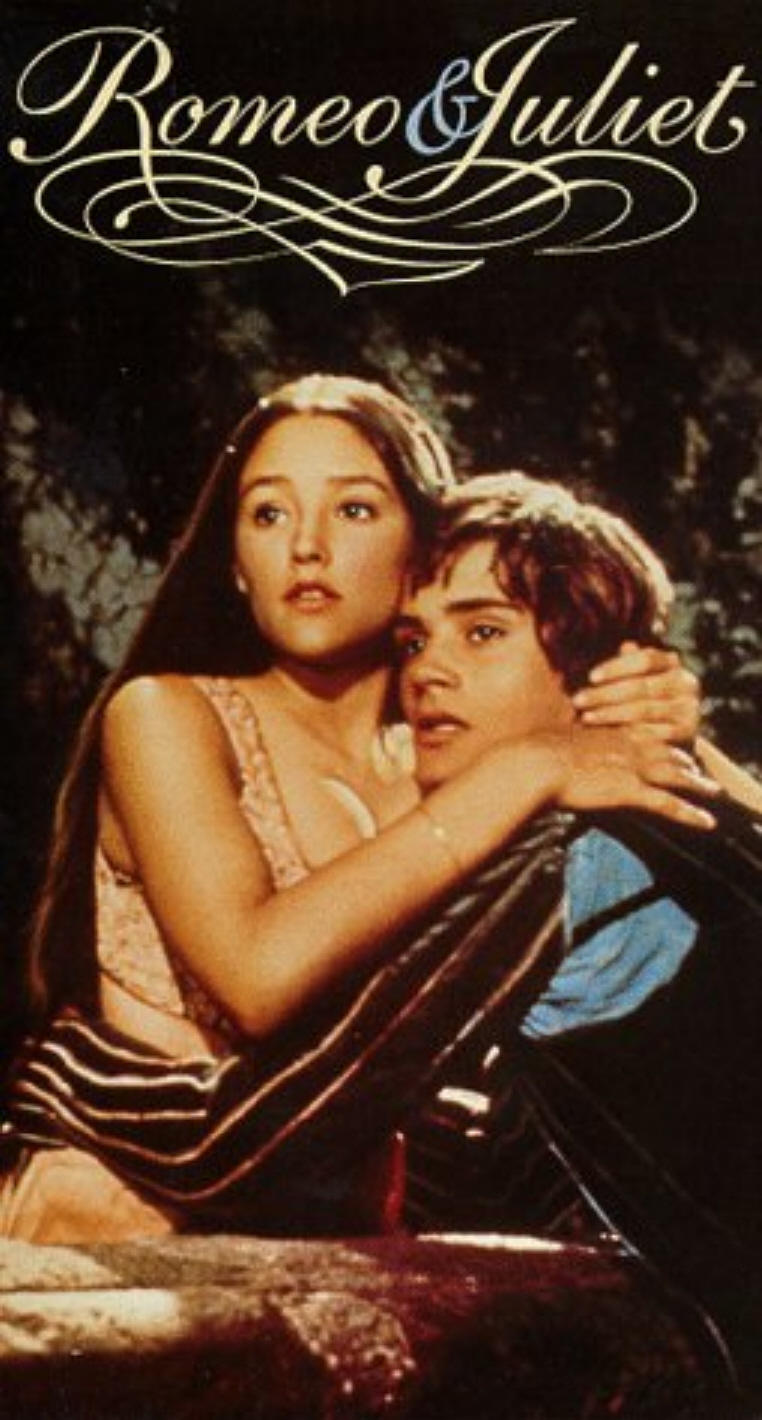
 Beginnings of final project research: Watched Zeffirelli version of Romeo and Juliet last night. Some very interesting stuff. (I gotta say, the pants were my favorite part.) My biggest concern-and--and this is a big concern--is how we're going to get the essence of the love story in three, one-and-a-half minute scenes. I have confidence that we can! I literally have the best group in the WORLD so I have no doubt we can accomplish this task.
Thursday, November 10, 2011
Romeo Wherefore art thou?
Beginnings of final project research: Watched Zeffirelli version of Romeo and Juliet last night. Some very interesting stuff. (I gotta say, the pants were my favorite part.) My biggest concern-and--and this is a big concern--is how we're going to get the essence of the love story in three, one-and-a-half minute scenes. I have confidence that we can! I literally have the best group in the WORLD so I have no doubt we can accomplish this task.
Tuesday, November 8, 2011
Shakespeare's Specific Series'
Shakespeare is very good at having his characters really EMPHASIZE their points with series'. for example: Glouster says, "we have seen the best of our time:" this alone might have made his point. BUT he takes it a step further with this:
"machinations, hollowness, treachery and all ruinous disorders follow us disquitely to our graves" (Act I scene II)
He did not have to give us that detailed description of what is left, but because he did, it gives the reader/audience memeber a sense of much deeper, and much more specific despair.
He uses series to make a local point very global:
"love cools, freidnship falls off, brothers divide: in cities, mutinies; in countries, discord; in palaces, treason; and the bond craked 'twixt son and father" (act I Scene II)
So many problems in the world, and he compares a bond broken between a father and son to treason in a kingdom. We then get a sense of how deeply he feels betrayed because of this juxtaposition.
To emphasize loyalty: Kent could have easily just said, "I will serve loyally" but instead takes it that much further, and swears loyalty in a much stronger way when saying:
"to serve him truly that will put me in trust; to love him that is honest; to converse with him that is wise and says little; to fear judgement; to fight when I cannot choose, and to eat no fish"(act I scene IV)
Shakespeare creates a witty fool with wordplay:"they'll have me whipped for speaking true, thou'lt have me whipped for lying, and sometimes I am whipped for holding my peace" (act I scene IV)
 In empasizing incredulousness at his daughters' lecherous behaviour:
"They durst not do't;
They could not, would not dot; 't is worse than murder" (Act II scene IV)
By use of word-play and series, Lear's feelings are magnified and maddened. Truely creating a clear image of frustration and anger (even without seeing an actor perform it)
"You think I'll weep; No, I'll not weep:
I have full cause of weeping; but this heart
Shall brake into a hundred thousand flaws,
Or ere I'll weep." (Act II scene IV)
"machinations, hollowness, treachery and all ruinous disorders follow us disquitely to our graves" (Act I scene II)
He did not have to give us that detailed description of what is left, but because he did, it gives the reader/audience memeber a sense of much deeper, and much more specific despair.
He uses series to make a local point very global:
"love cools, freidnship falls off, brothers divide: in cities, mutinies; in countries, discord; in palaces, treason; and the bond craked 'twixt son and father" (act I Scene II)
So many problems in the world, and he compares a bond broken between a father and son to treason in a kingdom. We then get a sense of how deeply he feels betrayed because of this juxtaposition.
To emphasize loyalty: Kent could have easily just said, "I will serve loyally" but instead takes it that much further, and swears loyalty in a much stronger way when saying:
"to serve him truly that will put me in trust; to love him that is honest; to converse with him that is wise and says little; to fear judgement; to fight when I cannot choose, and to eat no fish"(act I scene IV)
Shakespeare creates a witty fool with wordplay:"they'll have me whipped for speaking true, thou'lt have me whipped for lying, and sometimes I am whipped for holding my peace" (act I scene IV)
 In empasizing incredulousness at his daughters' lecherous behaviour:
"They durst not do't;
They could not, would not dot; 't is worse than murder" (Act II scene IV)
By use of word-play and series, Lear's feelings are magnified and maddened. Truely creating a clear image of frustration and anger (even without seeing an actor perform it)
"You think I'll weep; No, I'll not weep:
I have full cause of weeping; but this heart
Shall brake into a hundred thousand flaws,
Or ere I'll weep." (Act II scene IV)
Saturday, November 5, 2011
Really Rough Draft of Script
Here's our outline as we discussed as a cast today:
the plan is to have it written by this thursday so that we can compile it all together!
(don't forget to make each scene aprox. 2-3 minutes long, and we'll cut it down from there)
the plan is to have it written by this thursday so that we can compile it all together!
(don't forget to make each scene aprox. 2-3 minutes long, and we'll cut it down from there)
| | Scene 1 | Scene 2 | Scene 3 | Scene 4 |
| Romeo & Juliet | Look. Love. Hands touch. (I think a giggle would be appropriate) | Balcony, forswear parents, and wedding | Outside influences | Deaths |
| | | | | |
| Hamlet & Ophelia | He’s reading her a love letter | He talks to his dad; she talks to hers | “get thee to a nunnery” backstage: “splash” | |
| | | | | |
| King & Princess | He swearing off love for oath, she’s rowing in from a boat. Witty banter | He’s talking to friends; she’s reading letter with friends | In love, but must prove himself/must let go | |
Thursday, November 3, 2011
Powerful Men with Short Tempers
Shakespeare seems to like setting up his characters with outrageous and fatefull stubbornness. I noticed strong parallels between King Lear and Leontes (from The Winter's Tale)
LEONTES is convinced that his faithful wife is cheating on him with his best friend. He rashly accuses her, puts her in prison, banishes their child, and nothing anyone says can sway him otherwise. He gets caught up in pride, and the idea of being decieved and played a fool, makes him so mad, that he in fact becomes the fool.
"Go, play, boy, play: thy mother plays, and I
Play too, but so disgraced a part, whose issue
Will hiss me to my grave: contempt and clamour
Will be my knell. Go, play, boy, play.
There have been,
Or I am much deceived, cuckolds ere now"
 KING LEAR is suddenly convinced that his most virtuous daughter does not love him, because she was honest in the amount of love (unlike her two scheming sisters, who in fact did NOT love him as much, but could flatter). Lear disinherits her, and not even his faithful, long-serving companion could sway him otherwise.
"Propinquity and property of blood,
And as a stranger to my heart and me
Hold thee, from this, for ever. The barbarous Scythian,
Or he that makes his generation messes
To gorge his appetite, shall to my bosom
Be as well neighbour'd, pitied, and relieved,
As thou my sometime daughter."
LEONTES is convinced that his faithful wife is cheating on him with his best friend. He rashly accuses her, puts her in prison, banishes their child, and nothing anyone says can sway him otherwise. He gets caught up in pride, and the idea of being decieved and played a fool, makes him so mad, that he in fact becomes the fool.
 |
| Leontes and his bewildered accused Queen Hermione |
Play too, but so disgraced a part, whose issue
Will hiss me to my grave: contempt and clamour
Will be my knell. Go, play, boy, play.
There have been,
Or I am much deceived, cuckolds ere now"
 KING LEAR is suddenly convinced that his most virtuous daughter does not love him, because she was honest in the amount of love (unlike her two scheming sisters, who in fact did NOT love him as much, but could flatter). Lear disinherits her, and not even his faithful, long-serving companion could sway him otherwise.
  |
| Two mean daughters, and the nice one |
And as a stranger to my heart and me
Hold thee, from this, for ever. The barbarous Scythian,
Or he that makes his generation messes
To gorge his appetite, shall to my bosom
Be as well neighbour'd, pitied, and relieved,
As thou my sometime daughter."
I'll bet we'll see a similar downfall as we did with Leontes. But maybe without as forgiving an ending...
Tuesday, November 1, 2011
Midterm Self-Assessment Post
Learning Outcomes
- Gained Literacy
- When I saw Macbeth this past weekend, I got so excited, because I could understand it! I didn't read any synopsis before-hand, and I had next to no idea what the play was about. But I followed the story from the actors, and it was awesome! On my very first post I wrote about how I started reading this semester with the spark-notes English translation off to the side. Now that I can actually, (basically) completely understand him, it is incredible fun. I'd only ever read two other plays by Will, but now feel like an educated citizen of the Shakespearean world because of the five shows I have read in depth, and analyzed, certainly more-so than I have ever before. I feel like I have a grasp of his works, an idea of how to look at a performance, and resources to find new and contemporary media on the subject.
Monday, October 31, 2011
Shakespearean Weekend
This weekend was so much fun! I felt transported back to an era of Elizabethian proportions.
 Friday night I saw MacBeth with the Grassroots Shakespeare Company and they did a PHENOMINAL job. The show was minimal and goofy: they had no budget, no director, 2 weeks of rehearsal, and were borrowing the venue. Each character costumed/prop-ed themselves, and they staged the play as a cast. It was the true Shakespearean expirience:
I was a groundling.
The cast jumped in and out of the audience
the audience shouted at the performers.
one of my favorite moments of the evening was when Lady MacBeth said, "out damn spot!" and a groundling shouted "TRY CLUB SODA" bah ha ha
with all these distractions, they kept the integrity of the play, and it was incredibly powerful.
 Friday night I saw MacBeth with the Grassroots Shakespeare Company and they did a PHENOMINAL job. The show was minimal and goofy: they had no budget, no director, 2 weeks of rehearsal, and were borrowing the venue. Each character costumed/prop-ed themselves, and they staged the play as a cast. It was the true Shakespearean expirience:
I was a groundling.
The cast jumped in and out of the audience
the audience shouted at the performers.
one of my favorite moments of the evening was when Lady MacBeth said, "out damn spot!" and a groundling shouted "TRY CLUB SODA" bah ha ha
with all these distractions, they kept the integrity of the play, and it was incredibly powerful.
- My second shakespeare show this weekend was The Tempest put on by The Pioneer Theater Company at the University of Utah. It was fantastic. Some highlights:
- the stage was set up like a workshop, with a stage in the middle. The magic Prospero produced was compared to the magic of Shakespeare putting on a play.
- there was a very interesting relationship between Prospero and Ariel that they portrayed through a series of attempts to physically connect hands, then when prospero gave up his magic, they could for the first time touch. It was a moving moment, and added depth to their characters/relationship that was not written in the text.
- we got to talk to the cast after for a few minutes. They all seemed like very neat people. One kind of funny phenomenon was Ariel spoke and moved her hands almost the EXACT same way she did on stage in character

Quite the Wonderful Weekend in my opinion.
Social Discovery
I have actually already done this, but forgot to add it to my post.
Originally I thought I would look at the historical accuracy of Julius Ceasar, but then changed my mind. In the process, however, i came across this neat dialogue on the site "All Empires History Forum" on the Historical Accuracy of the Play.
Some interesting highlights:
One teacher on Good Reads, Bill Kerwin, said that every year (for over thirty years) his opinion of whom he likes better, Cassius or Brutus, changes. That's very interesting to me.
There is far too much analysis on this play to write about half of what I found. But it goes to show how many people are captivated by Shakespeare, and specifically Julius Caesar.
Originally I thought I would look at the historical accuracy of Julius Ceasar, but then changed my mind. In the process, however, i came across this neat dialogue on the site "All Empires History Forum" on the Historical Accuracy of the Play.
Some interesting highlights:
- "Shakespeare's immediate source for history was Raphael Holinshed's Chronicles of England, Scotland, and Ireland(1577) but he was an avid reader who used lots of sources."
- "Et tu Brute?" was a fictional line, however, according to Suetonius, in Greek, Caesar was rumoured to have said was "even you my child?"
- The murder actually did take place on the Ides of March
- and apparently it would not have been that uncommon to have all the senators carry weapons on their person. WHO KNEW?
One teacher on Good Reads, Bill Kerwin, said that every year (for over thirty years) his opinion of whom he likes better, Cassius or Brutus, changes. That's very interesting to me.
There is far too much analysis on this play to write about half of what I found. But it goes to show how many people are captivated by Shakespeare, and specifically Julius Caesar.
Subscribe to:
Posts (Atom)